Corona’s Research Supports Child Care Works
4/17/26 / Jim Pripusich

We are excited to announce that Corona Insights is a member of the Child Care Works Narrative Cohort, serving as the Story Research Measurement and Analysis Leader. Child Care Works is a nonpartisan, community-centered movement dedicated to bringing attention to Colorado’s child care crisis through grassroots storytelling.
The cohort is composed of Colorado small businesses, child care experts, journalists, rural leaders, military advocates, filmmakers, and artists. Together, with philanthropic support from Gary Community Ventures, we are collecting and sharing stories about how our unaffordable, inaccessible child care system impacts everyone.
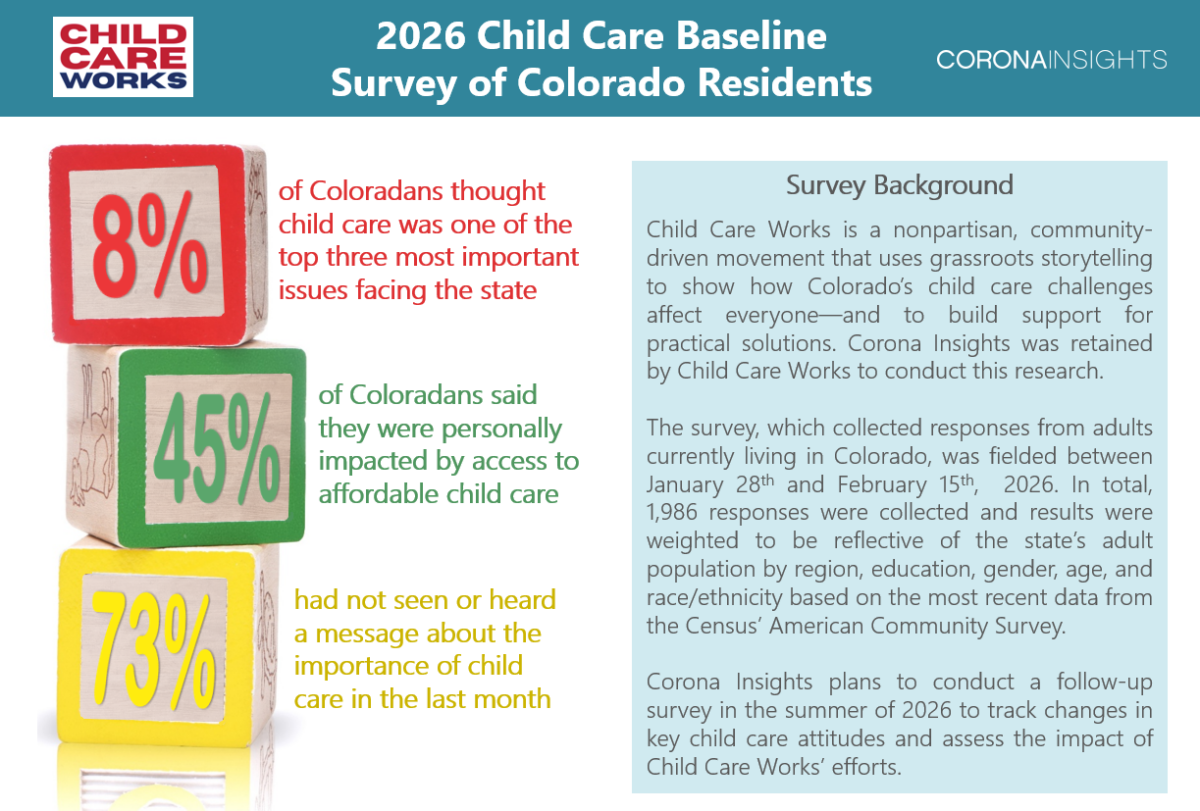
Screenshot of Corona’s Child Care Works baseline survey one-pager
As a part of this effort, Corona is conducting a pre-post survey to understand the current conversation around child care in the state, experimentally test messages, and evaluate the impact of the cohort’s efforts. Highlights from the baseline survey can be found here. Child care was much less likely to be viewed as a top issue facing Colorado than housing, the economy, and healthcare. While nearly half of the state said they were personally impacted by access to affordable child care, nearly three out of four had not seen or heard a message about the importance of child care in the last month.
Key findings from the baseline survey highlight that the cost of child care is top-of-mind, but often underestimated. When thinking of child care in Colorado, “Expensive” or “Cost” was the first word or phrase that came to mind for 40% of residents and only 10% said child care was affordable. However, most (54%) estimated average costs to be below the actual cost of $15,000+ a year, per child. Additionally, fairness was critical to many Coloradans. To be seen as fair, investments to make child care more affordable must be shown to benefit not only current parents, but also past parents, those with older children, and those without children. Narratives on the broad economic effects of these efforts could help address concerns about the fairness of child care investments. Most Coloradans (61%) thought expanding access to affordable child care would improve the state’s economy at large. A similar share (60%) were convinced that investing in child care provides benefits for the whole community with a more competitive workforce.
The baseline survey also experimentally tested a series of messages to clarify the importance of Colorado’s child care system and highlight the issues its facing. The share of residents who said they were personally impacted by the availability of affordable child care increased from 45% to 67% after messaging. While messages were viewed positively, those focused on 90% of a child’s brain developing before the age of five (child development) or the average Colorado family spending about $1,600 each month, per-child on care (affordability) performed slightly better than alternatives. Additional detailed survey reporting can be found here.