Corona Quantifies the Value of Sober Living
10/5/26 / Paul Collier

Late last year, the Abundance Foundation engaged Corona Insights to model the economic impact of its recovery services. Abundance is an innovative Fort Collins nonprofit that combines gender-specific sober living homes, peer-led recovery coaching, and community-building events to support people in recovery, many of whom are transitioning out of treatment, detox, or jail.
We previously helped Abundance create a simple but comprehensive assessment tool to track outcomes among its alumni. This time, Abundance wanted to communicate its results in a way that resonates with a broader audience, including people who may not have a personal frame of reference for addiction. To do this, we conducted a Social Return on Investment (SROI) analysis, a method for measuring the broader economic value that social programs create.
We started by using high-quality research to set reasonable assumptions for the SROI model and to adjust costs for Larimer County. We reviewed (and agonized over) more than 45 sources, including public datasets and peer-reviewed studies. One result of this step was a defensible estimate of the cost of untreated addiction: in Larimer County, untreated addiction results in nearly $35,000 in lost earnings and system costs per person, per year.

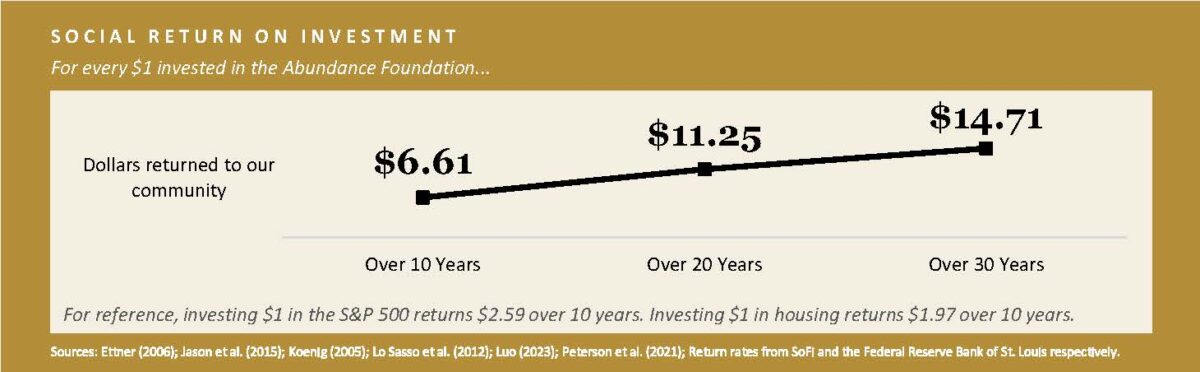
Next, using peer-reviewed research as a guide, we estimated the impact of a program like Abundance’s on three critical outcomes: earnings, healthcare utilization, and criminal justice involvement. We discussed other outcomes at length but ultimately focused on these three because they had the strongest research base. Combining this research with Abundance’s data on its 2025 graduates, program costs, and alumni outcomes allowed us to estimate the SROI of Abundance’s services, which grows over time as participants sustain their recovery. Over 10 years, every $1 invested in Abundance’s programming returns $6.61 to Larimer County.
Finally, to put this information in context for people who might not be familiar with this issue, we estimated how much addiction affects taxpayer-funded systems of support. These systems (i.e., healthcare, social services, and criminal justice) are the first line of response for people struggling with addiction, and serving people with untreated addiction can limit the resources these systems have to respond to other community needs. Through this work, we found that of the taxes paid by the average Larimer County homeowner, 25% fund systems that are directly impacted by addiction.

Abundance has since shared our analysis with other recovery service providers and funders in Larimer County, as well as with its broader community of donors. You can find the one-page summary and the technical appendix, which describes the SROI model in detail, at: https://www.abundancefoundationinc.org/sroi/